Who Are the Inklings?
In many ways, of course, it is very presumptuous of me to use the title “Inkling,” so I must clarify not only who the Inklings were for those who do not know, but also explain that I am, in no way, elevating myself to their ranks. Rather, I seek to follow their leads as writers and thinkers who shaped my own intellectual development as well as the creative and moral imaginations of millions of others.
I’m sure many of you are already well acquainted with the Inklings in some form or fashion. Perhaps you are already well aware of the perfect storm of collaboration, encouragement, and inspiration created by these authors who met together, sometimes regularly, sometimes sporadically, in the middle of the twentieth century in Oxford, England. You may have even studied this remarkable literary team-up as a model of the ideal writing community. If you ever survived being a student in one of my composition courses, you probably heard about the Inklings in our discussion of the value of writing groups. It is also highly likely that you have encountered the work of one of the more famous Inklings. Whether you read The Hobbit in middle school or Mere Christianity as part of a study, the words of J.R.R. Tolkien or of C.S. Lewis perhaps connected to you at an important point in your life. You may have even been intrigued or inspired by one of the less commercially successful members of the group, like the remarkable but definitely enigmatic Charles Williams. Perhaps, though, you are entirely unfamiliar with these remarkable minds, except for enjoying a film adaptation or other popular culture reference to one of their works. If so, it is my great honor to introduce to you the Inklings.
Beginning in the early 1930s, the Inklings meetings included gatherings at Lewis’s rooms in Oxford as well as ones in the Eagle and Child pub, which members of the group generally called “the bird and baby.” While there was no formal membership and no formal structure to the meetings, the members usually got together to share their current writing projects and to discuss literature and ideas, usually over a pipe and a pint. The membership changed over the years, and, as friendships do, the relationships of the Inklings changed, too; at various times, the discussions were sometimes less literary and more social, but there is no doubt that this group had a profound effect on the world of books and ideas. Some of those effects are very specific. For example, if not for the Inklings, who urged Tolkien to complete The Lord of the Rings, the Fellowship might still be sitting outside the secret entrance to the Mines of Moria. Other effects are more ephemeral, from the ways these writers inspired and challenged each other to the way they still serve as role models for those of us who love the sort of books and ideas they loved and the fellowship of like-minded readers and writers. Lewis once asked in a letter if there were “any pleasure on earth as great as a circle of Christian friends by a fire?” That circle is now probably more vast than the original Inklings ever anticipated, but it includes a great many of us who are drawn to join them, to draw up our chairs next to the fire, warmed more by the brilliance of their words than by any heat source we could coax from wood or coal. I am thankful to be part of that great circle, and I am delighted you’ve come to join me. Find a comfortable chair and get yourself a big cup of tea (Lewis famously believed that neither books nor cups of tea could be too big). Welcome to the fireside; there is plenty of room.
If you would like to learn more about the Inklings, there are several excellent books that go into great detail about the phenomenon of this group. Below, find some I can recommend if you would like to learn more:
The Inklings by Humphrey Carpenter (Houghton Mifflin,1979)
First published in 1978, this has long been considered the first and most important book on the Inklings. There are others now, and some more recent scholars have questioned some of Carpenter’s statements and conclusions, but it remains a pivotal piece of scholarship into all or any of the Inklings.
Tolkien and C.S. Lewis: The Gift of Friendship by Colin Duriez (HiddenSpring, 2003)
Although focused primarily on just Lewis and Tolkien, rather than on the entire group of Inklings, this is a great look at the relationship between the group’s two best-known members. It includes a wonderful parallel timeline that traces important events in the lives of the two writers.
The Company They Keep: C.S. Lewis and J.R.R. Tolkien as Writers in Community by Diana Pavlac Glyer (Kent State University Press, 2008)
Based on years of in-depth research into documents, manuscripts, letters, and more, Diana Pavlac Glyer’s brilliant look at the Inklings is more than a history of this specific group: it is a transformative look at the way community and writing relationships foster creativity in this group and beyond.
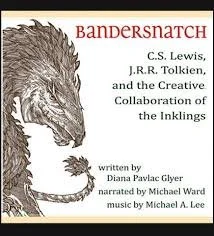
Bandersnatch: C.S. Lewis, J.R.R. Tolkien, and the Creative Collaboration of the Inklings by Diana Pavlac Glyer (Kent State University Press, 2015)
This beautiful book features fantastic illustrations by James A. Owen and, in addition to telling the story of the Inklings and their collaborative process, examines the way in which readers may learn from that process and themselves grow as writers, artists, and thinkers. Like The Company They Keep, Bandersnatch demonstrates how community facilitates creativity, but in a more general-readership-friendly format that can inspire readers from a wide variety of backgrounds as well as those already familiar with the Inklings.