
In the Bleak Midwinter
Those of us who have traveled to Narnia with C.S. Lewis know a bit about the power of winter. Lewis did not begin writing The Lion, the Witch, and the Wardrobe until he was an adult, but he had been haunted by the image of a queen on a sledge since he was a child. He often wrote to give life to images that intrigued him, and that image was one that was there, in the back of his mind, long before he crafted the words that brought to life the White Witch of Narnia, once Jadis, Empress of Charn.
Lewis was always drawn to a sensation he called “northerness,” an impression of cold, and snow, and vast polar skies. It was one of the common interests he held with Tolkien, connected to their mutual interest in Icelandic epic poetry. That sense of winter, in all its beauty, power, danger, cold, dark, and silence, is a powerful thread in Lewis’s writing, a thread nowhere more obvious than in the first of The Chronicles of Narnia. I can (and often do) discourse at length upon why The Lion, the Witch, and the Wardrobe should be read first, and why The Magician’s Nephew goes just before The Last Battle, but the short answer is that the most magical way to enter Narnia is through the wardrobe, holding hands with Lucy. We should all go through those wooden doors, push back those furs until they become firs, and place our feet upon wood, and then, snow. There are few moments in literature that enchant the reader like the moment Lucy finds herself beneath that lamppost. Even before Mr. Tumnus arrives, arms full of packages, the moment pulls us inexorably into Lewis’s imagination.
I have always loved that moment, and it is one I cling to, as the actual winter that surrounds me is often not that enchanting. Here, in the mountains, we usually get a fair bit of snow. It can be beautiful. Thankfully, as an instructor at a lovely college that is very attuned to student and staff safety, I am usually able to teach remotely. When I do I have to get out in the winter, the truck usually does just fine in the snow as long as we park wisely. However, last weekend, our region was blasted with a freak winter storm that coated us in ice. I am very thankful that our impact was not as bad as forecasted. We kept power and kept warm. We do not have a beautiful snowy Narnian landscape. The ice on the trees was pretty at first, but each day, with watery sunlight and frequent single-digits, the ice, originally 1-2 inches on roads, walks, and vehicles, has grown ever more treacherous. Currently, our road looks like it has been glassed over, and the hills look like metal. Even with ice cleats over my boots, the ice is unrelenting and incredibly dangerous. Although we have food and supplies, we are watching another storm that is predicted to drop another foot of snow over the ice, so we thought we should try to re-supply. Driving was out of the question, but the main road is clear, so I hiked down, ice cleats one, stick in hand, dragging my children’s old sled with a package my husband needed to mail and my grocery bags. I met my wonderful friend, who carried me to the post office, coffee shop, and grocery. Then, we loaded the supplies on the sled, bungeed them down, and I hiked back up the icy road to the house.
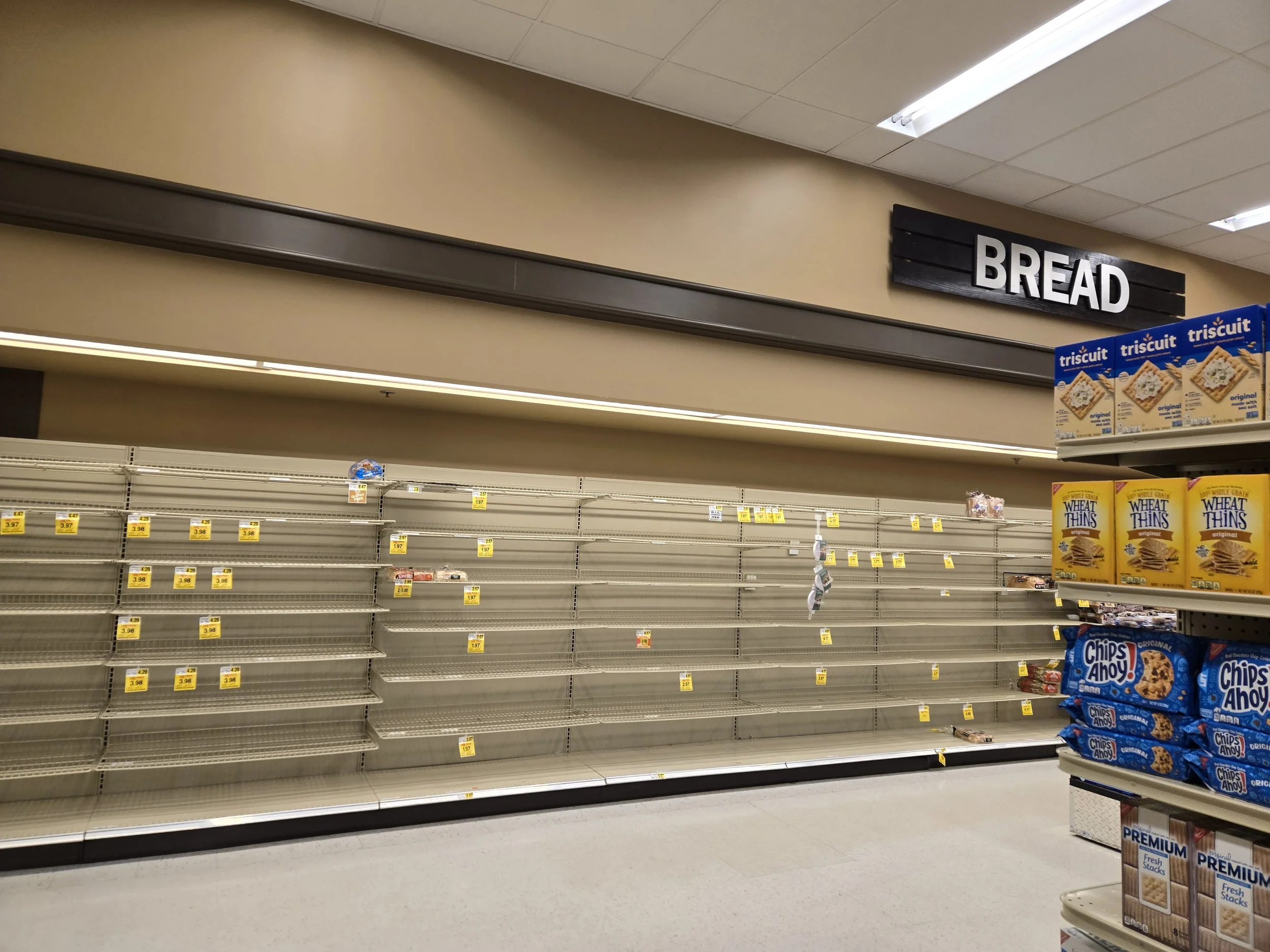
My otherwise well-supplied local grocery…
It’s quite steep, and I was thankful for my husband’s help, especially once I hit a dry patch and the sled no longer moved smoothly behind me. As I trundled along, I thought often of Narnia, of the Witch’s sledge no longer working properly once Aslan’s arrival begins breaking her hundred-year winter spell, of Tumnus and his packages (my husband was mailing books, very appropriately), of the frozen cataracts of water at the Beavers’ home. I also remembered the old fairy tale about the princess on the glass mountain. The mountain is nearly unclimbable, and I understand much better now the challenge the hero faced in that story.
I’m deeply grateful to be back home with my wonderful family and our provisions, sitting by my space heater with a warm cat at my back. I am trying to re-romance winter, to love that northerness that so enchanted Lewis. There is more to winter than bare bread racks at the store, soggy spots all over the floor by the door, and high electric bills. There is the incredible beauty of God’s creation, but there is also His provision, and his reminders of His constant presence. Even when winter, or life in general, is far less than magical, God is always good, and He is always on the move. Spring is coming.
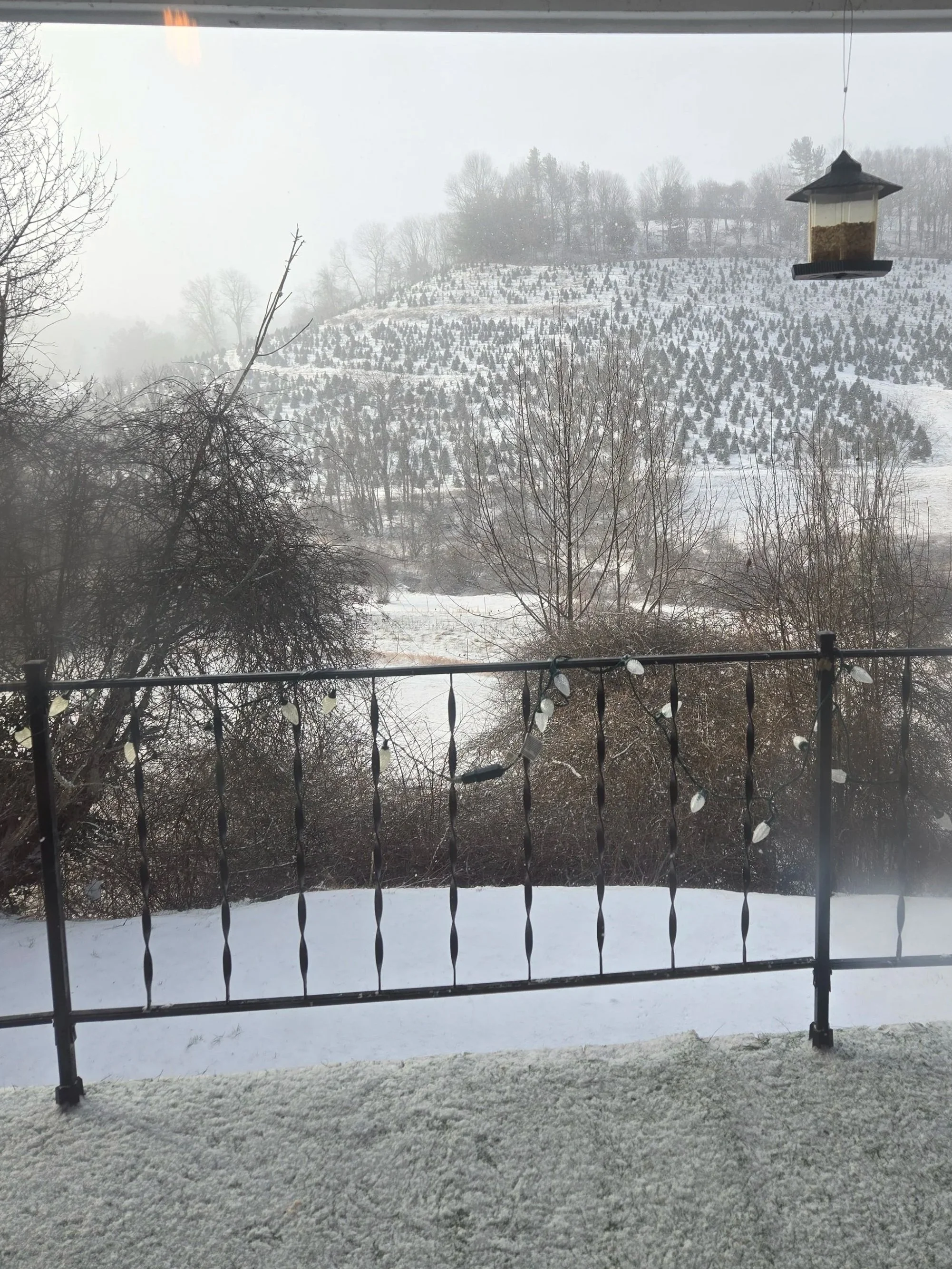
Out the back door, just before the ice began